
Taiko in autumn: When all of Japan celebrates
When the leaves start to fall in October back home, one of the most vibrant times of the year begins in Japan. Autumn festivals, known as Aki Matsuri, take place all over the country. And almost everywhere, drums are part of the festivities.
For many of us, Taiko is primarily stage music: ensemble, choreography, performance. But its roots lie elsewhere. Long before Taiko groups existed in the modern sense, drums were played at festivals to honor deities, propel processions, and bring the community together.
Why it's worth taking a look at the Matsuri
Those who understand where Taiko comes from often play with more intention. The Matsuri show what drumming is fundamentally about: rhythm that moves people and music created together. The ensemble Taiko we know today only emerged in the 1950s. Festival music, on the other hand, has been passed down from generation to generation in many places for centuries.
Furthermore, you will encounter instruments at autumn festivals that are also used by many groups here. If you have ever held a Chanchiki or Chappa, you will recognize them in Matsuri music.
What are Aki Matsuri?
"Aki" means autumn, "Matsuri" means festival. Aki Matsuri are the autumn festivals celebrated throughout Japan at shrines and in city districts. Many of them originate in giving thanks for the harvest and honoring local guardian deities.
Splendid floats, portable shrines (mikoshi), processions through the streets, and lots of music are typical. Often, each float belongs to a specific district that maintains it, decorates it, and accompanies it during the festival with its own music group.
The role of the drums
Matsuri music is called Matsuri Bayashi, or Hayashi for short. It is usually played by a small group: drums, a bamboo flute, and a metal instrument that keeps the basic beat. The drums provide energy and tempo to the procession, while the flute carries the melody.
Exciting for Taiko players: Many of these pieces are not learned from sheet music, but by listening, playing along, and using Kuchi Shōga - that is, speaking the rhythms with syllables like "don" and "ka." This is exactly how many groups here still learn today.
Three well-known autumn festivals in October
Nagasaki Kunchi (October 7–9)
The Kunchi in Nagasaki is the great autumn festival of the Suwa Shrine and has been celebrated since 1634. Because Nagasaki was Japan's gateway to the world for a long time, Japanese, Chinese, and Dutch influences blend here. The dragon dance, Ja Odori, accompanied by drums and gongs, is particularly famous.
Especially interesting for Taiko fans is the Kokkodesho. In this event, an elaborately decorated drum structure, the Taikoyama, is tossed into the air and caught again by a large group of bearers. The frame weighs about a ton. The city districts take turns and only perform every seven years, which is why the festival looks different every year.
Takayama Autumn Festival (October 9 and 10)
The Hachiman Festival takes place in autumn in the mountain town of Takayama. Artfully decorated floats parade through the old town, and on some of them, mechanical Karakuri puppets perform little shows. In the evening, the floats light up in the glow of hundreds of lanterns. Drums, flutes, and singing accompany the procession.
Kawagoe Matsuri (Third weekend in October)
Kawagoe, northwest of Tokyo, is also called "Little Edo." On the third Saturday and Sunday in October - in 2026, October 17 and 18 - elaborately built floats parade through the historic old town. On each float sits a Hayashi group consisting of five musicians and a masked dancer.
The highlight is the Hikkawase in the evening. When two floats meet, the stages turn toward each other and the groups play against one another. Each wants to outdo the other in energy and precision. A musical trial of strength that is hard to imagine being any more exciting as a Taiko player.
The instruments of Matsuri music
Depending on the region, the festival music sounds different, but some instruments appear almost everywhere.
Taiko: Usually a larger drum for the deep bass sound and one or more small, tightly stretched drums similar to the Shime Daiko. The small drums play fast, intricate patterns and drive the tempo. If you play Shime in your group, you know how much control that requires. There are dedicated, slimmer Shime Bachi for this.
Fue: The Japanese bamboo flute carries the melody and often cues the starts.
Chanchiki: A small metal gong played with a mallet made of deer antler or wood. Its bright, piercing sound keeps the basic beat and is easy to hear even in the bustle of a procession. In many of our groups, the Chanchiki takes on the same task: it is the metronome of the ensemble.
Chappa: Small hand cymbals that additionally emphasize the rhythm at some festivals. Their sound is short and crisp, bringing movement to the music. With Chappa, you can also bring this character into your own pieces.
Practical tips: Matsuri feeling for your training
You don't have to travel to Japan to benefit from the spirit of the autumn festivals. A few ideas for you and your group:
- Practice Kuchi Shōga: Say new rhythms out loud before playing them. This trains your timing and helps you memorize pieces faster.
- Try a Hikkawase game: Divide your group into two halves facing each other. One side plays a short pattern, the other responds. This trains listening, reaction, and expression.
- Keep the beat with the Chanchiki: Have one person keep the pulse with the Chanchiki while everyone else plays over it. This way, you quickly notice who is rushing or dragging.
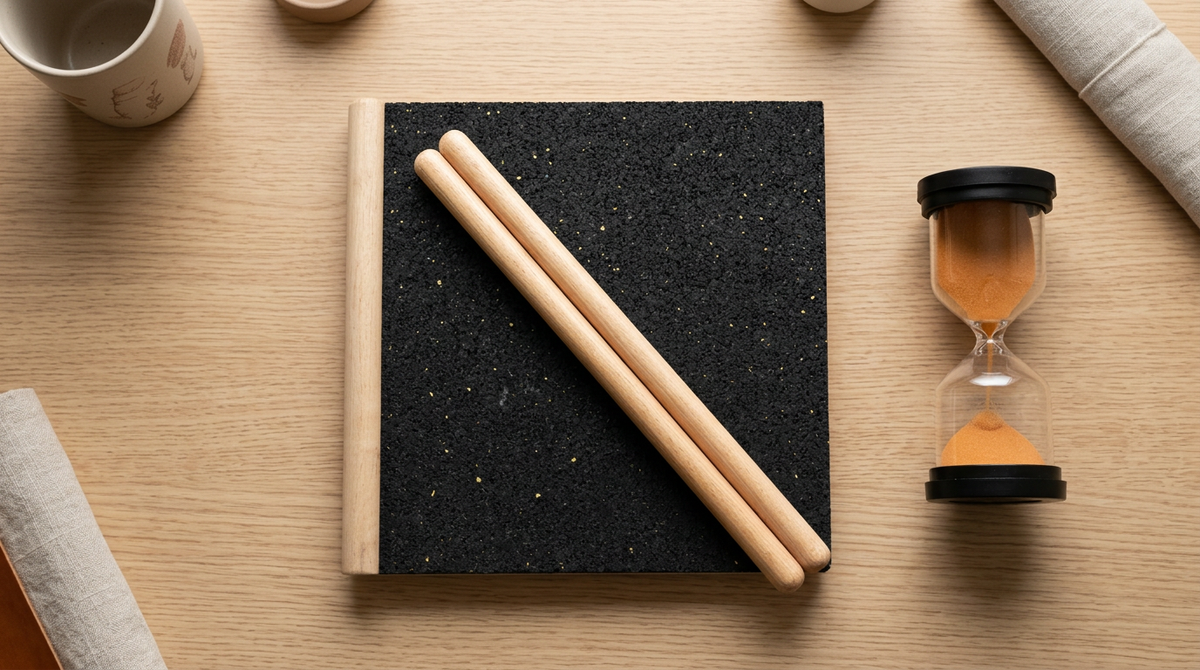
- Small drum, big control: The fast Shime patterns of festival music are well-suited for the practice pad. Play them slowly and cleanly, then increase the tempo.
- Listen to recordings: Look for videos of Kawagoe, Takayama, or Nagasaki and listen carefully. Pay attention to how drums, flute, and metal play together.
- Dress like it's a festival: A Tenugui headband is part of many Matsuri and keeps sweat out of your face while playing. Pair it with Tabi, which give you good stability and a feel for the ground.
A piece of Matsuri in every rehearsal
The autumn festivals show where Taiko comes from: from community, from celebration, and from the joy of shared rhythm. You can bring this energy into every rehearsal, regardless of whether you are just starting out or have been playing for a long time.
Perhaps October is a good occasion to try out a piece in the style of festival music with your group. And who knows, one day you might find yourself standing on the roadside in Kawagoe when the floats face each other.