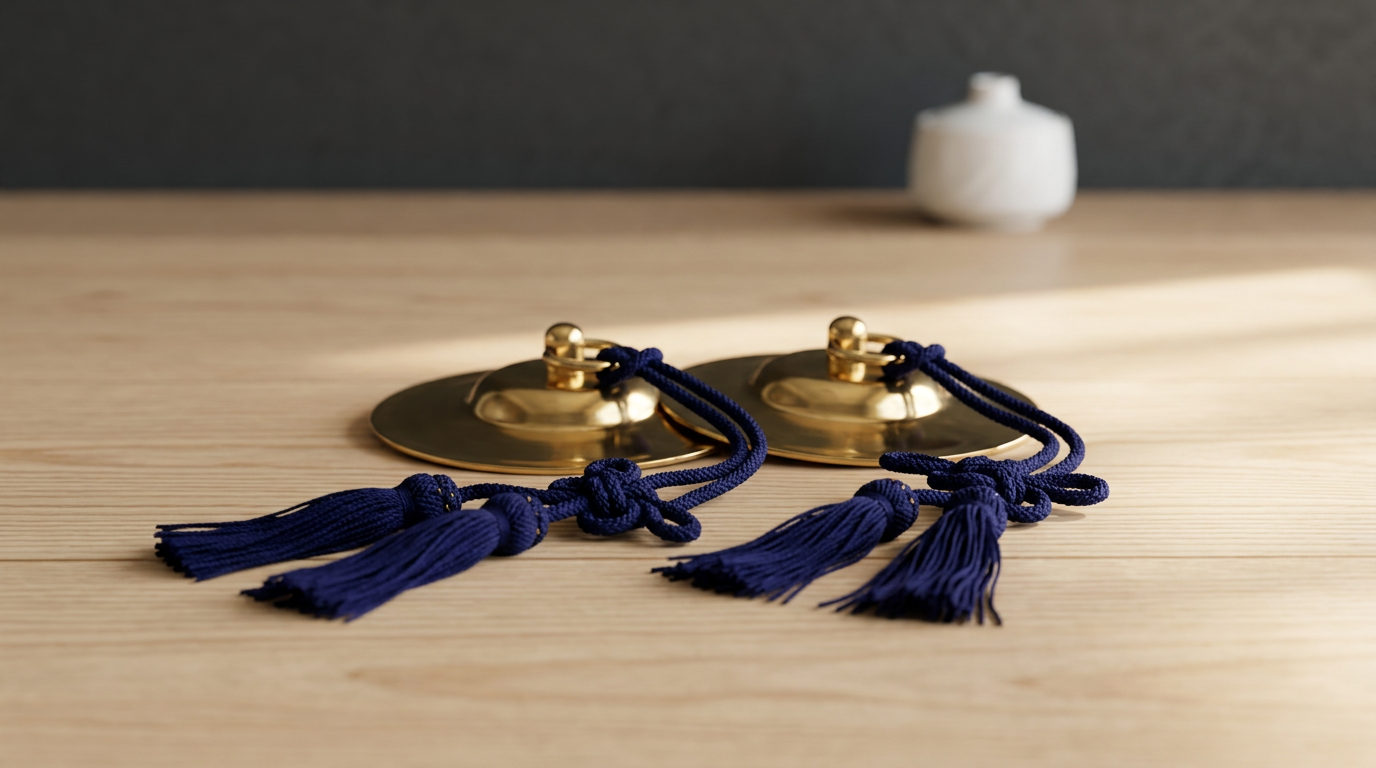
If you've ever seen a taiko group live, you've probably heard them without consciously noticing them: the chappa. These small hand cymbals usually sit in the background but still provide tempo and structure to the ensemble. Here's what chappa are exactly and what role they play in the ensemble.
Why chappa are important for your taiko playing
Taiko thrives on ensemble playing. The large drums provide power and depth, but without a unifying element, an ensemble would quickly drift apart. This is exactly where chappa come into play. They provide tempo, structure, and rhythmic orientation that the entire group can align with.
Learning to play chappa automatically develops a finer sense of timing and dynamics. This helps you not only with the cymbals themselves but also with drumming.
What exactly are chappa?
Chappa are a pair of small metal hand cymbals, usually made of brass. They are played by striking the two cymbals against each other.
Originally, chappa were purely accompanying instruments that supported the basic rhythm in the ensemble. In recent years, however, independent playing styles have developed, and solo performances with chappa are also becoming increasingly popular.
Sonically, chappa are more versatile than one might initially think. Depending on where and with what intensity you bring the cymbals together, different sounds emerge: open, ringing strikes, damped, closed sounds, or a long sustain when you rub the cymbals together. Experienced players speak of well over a hundred possible timbres, although in practice, a handful of fundamental sounds usually crystallize, on which everything else is built.
How to use chappa in an ensemble
In an ensemble, chappa primarily take on a rhythmic leading role. They carry recurring basic patterns, so-called Ji-patterns, which serve as beat anchors for the other players. Especially with Matsuri rhythms or other accompanying figures, chappa set the tempo and help the group stay synchronized.
In addition, many groups use chappa specifically for dynamic accents. A single, clear strike can mark an entry, introduce a transition, or add extra tension to a piece. Because the instrument is so small, it can be controlled precisely with minimal effort, making it ideal for fast, controlled movements.
Chappa as an integral part of the ensemble
Chappa may seem inconspicuous at first glance, but they play a crucial role in the ensemble. Once you have consciously perceived their effect, you hear taiko music with different ears.
If you want to work with chappa yourself, you can find brass chappa with us that are suitable for both training and stage.