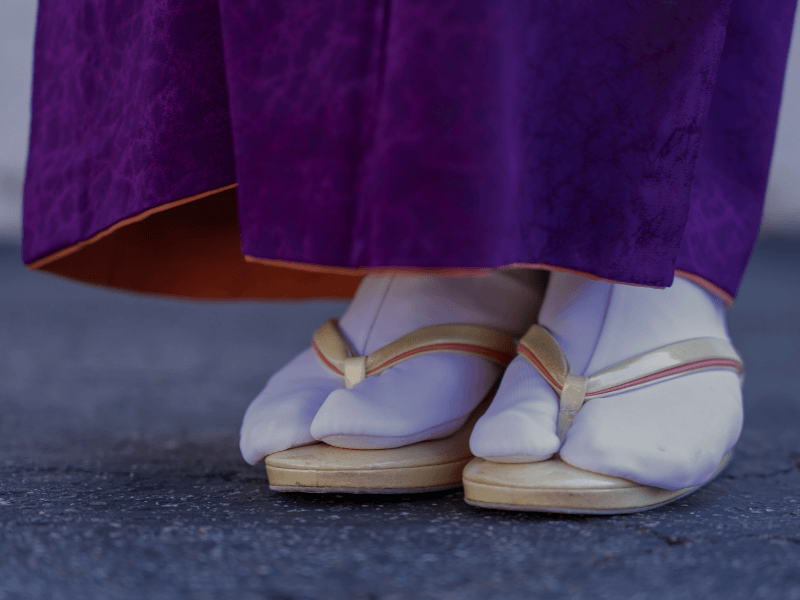
Anyone who studies japanese culture or taiko will sooner or later encounter a special item of clothing: Tabi. These traditional japanese shoes and socks are instantly recognizable by their distinctive feature – the separated big toe.
But tabi socks are not just a cultural symbol. Tabi socks are also extremely practical and are worn worldwide today, for example as flip-flop socks for sandals with a toe post.
What are Tabi?
Tabi are traditional japanese socks or shoes with a special construction: the big toe is separated from the rest of the foot.
This shape has a practical reason. In Japan, sandals with a toe strap, such as geta or zōri, were worn for a long time. Normal socks wouldn't work with them – tabi, however, would.
Typical characteristics of tabi:
- separated big toe
- close fit
- high wearing comfort
- ideal for shoes with toe straps
This special construction method makes tabi unique to this day.
Tabi socks: Tradition meets everyday life
The most well-known form is tabi socks. They are traditionally worn with japanese clothing such as kimonos, but are also very practical in everyday life.
Due to the separated toe:
- sandals fit more securely
- less friction is generated
- the foot remains mobile
That is precisely why tabi are also appreciated outside of Japan – especially as socks for flip flops .
Flip-flop socks: Why tabi are ideal for this
Many people want to wear flip-flops even in cooler temperatures. However, regular socks don't work because the toe strap sits between the toes.
This is where flip-flop socks come into play. Just like tabi socks, they have a separation between the big toe and the second toe, so the toe strap can be worn without any problems.
Advantages of tabi as flip-flop socks:
- comfortable wearing of flip-flops with socks
- no pressure points from the toe strap
- stable hold in the shoe
- pleasant warmth on cooler days
Tabi socks are therefore a practical solution for anyone who wants to combine sandals with socks.
Tabi shoes: The robust option
Besides socks, there are also tabi shoes. These also have the typical split toe, but are equipped with a stable sole.
The following are particularly well-known:
- Jika-Tabi – work shoes with flexible soles
- Tabi for traditional clothing
- modern options for sports and training
Tabi are also frequently worn when playing taiko drums because they offer good support while allowing freedom of movement.
Why many people find tabi so comfortable
The distinctive cut is not just about tradition. Separating the big toe can also support the natural rolling motion of the foot.
Many people report on:
- more stability when standing
- improved toe mobility
- comfortable to wear
This can be an advantage, especially in activities involving a lot of movement – such as dance, martial arts or taiko.
Tabi are more than just traditional socks
Whether as classic japanese tabi, as tabi shoes or as practical flip-flop socks – the principle of the separated toe has proven itself for centuries.
Tabi connects:
- tradition and everyday usability
- comfort and function
- cultural heritage and modern design
And that's precisely why more and more people are discovering this special type of socks and shoes – even far outside of Japan.